
As a woman, I’m aware that I’m being studied, except not in the way I want to be.
It’s no secret that sex and science are intertwined with one another. However, what’s uncommonly discussed is how the sexualization of women gained interest in the science world.
One could say, this idealization has shaped the equality index of women and men throughout time. This sexualization can be found in one of the world’s most prominent museums of science: The La Specola Museum.
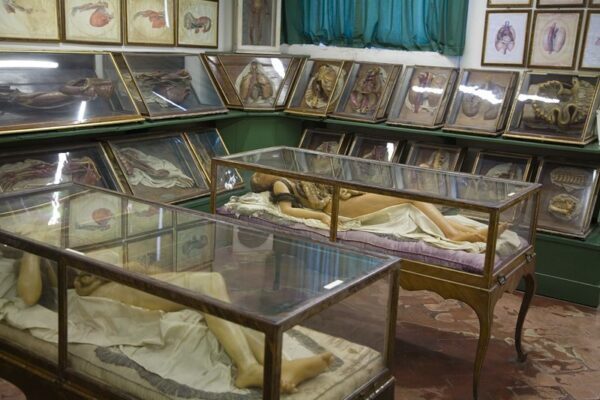
I recently visited the La Specola Museum in Florence, Italy. This museum was initially created in the eighteenth century to educate the highest-regarded scientists and doctors. Its main goal was to teach people about human anatomy in hopes that this enlightenment would lead to medicine and knowledge to prolong life.
I entered the museum’s most visited room through the Florentine corridors, holding the Anatomical Venus. Created by master ceroplastician (or wax artist) Clemente Susini, the Venus is a life-sized wax model of a woman trapped in a glass box. Beyond the curves of the wax, you’ll find a compartment that can be removed, which shows the internal organs of the female anatomy. She can be disassembled into seven anatomically correct layers, revealing, at the final removal, an unexpected fetus present inside the womb.
The Venus had beautiful locks of hair twisted just beside her generously sized breasts. Separating her gaze from her breasts was a string of pearls. The pearls were added to commit to the delicate vision of how a woman should be perceived. Just below the removable section of her ovarian area, you’ll find lush patches of pubic hair attached to the wax model. While peering past the vaginal showcase, I took note of how beautifully her feet were made to be. They had this dainty and airy feel, so relaxed and at ease.
Upon familiarizing myself with Anatomical Venus, I quickly took note of the permanence of her gaze. Her face was molded into an expression similar to having an orgasm. It felt unnecessary for this element to be added to a representation of a dead and pregnant female corpse.
Everything about Venus was sexualized in a way that would entertain the people who were studying her. Since most of those elite enough to attend the museum were men, perhaps one could assume that this Anatomical Venus was created to satisfy their tastes.
As I looked into her perfectly emulated hazel eyes, it felt as if the wax had disappeared, and I was staring into a real woman’s gaze upon which she was trapped in. This feeling jolted me like an electric shock as I resonated with this haunting figure. Like her, many women have felt trapped within this male gaze. Some still never find their way out.
Perhaps, the Anatomical Venus is not only a representation of what’s wrong with the perception of women hundreds of years ago but also today.
Now, let me walk you through the men’s anatomy section.
Here, you will find intricate wax models that have the opposite effect. They are perfectly detailed, leading the observer to an actual scientific anatomy journey.
There is no skin on these models. They are presented by gushing red veins, bulging organs, and skinned feet. The pure objection to studying these models is to understand the male anatomy. You aren’t seeing men displayed with rock hard glossy abs or lush locks of hair. To me, nothing about the representation of these scientific models leads to a mindset of sexualization.
One could say that the lack of distracting features in the men’s anatomic models would help deepen the study of the actual anatomy. From these replicated models, medicines and treatments were created to help the male anatomy, assuming they would also support the female anatomy.
For centuries, the same diagnosis and medicine that work for male bodies does not have the same effect on female bodies. This negligent notion is why so many women’s anatomical and medical issues, like Endometriosis and Adenomyosis, are just now being studied and treated. In fact, Adenomyosis is so unstudied that my spell check recognized it as a foreign word.
The men of the Enlightenment period looked at women’s bodies as a box to hold their future children. In other words, it was only studied because it served a purpose for them. Sadly, three hundred years later, the same notion prevails. We still continue to fight for access and purpose within our own bodies.
I’m aware that this was not Clemente Susini’s intention when creating Anatomical Venus in 1780. Whether on purpose or not, it led to how our bodies were handled and observed.
Not all women want to be marveled at. Not all women want to be “beautiful.”
We want to be equal.